

You must log in or register to comment.
Thank You. I did.
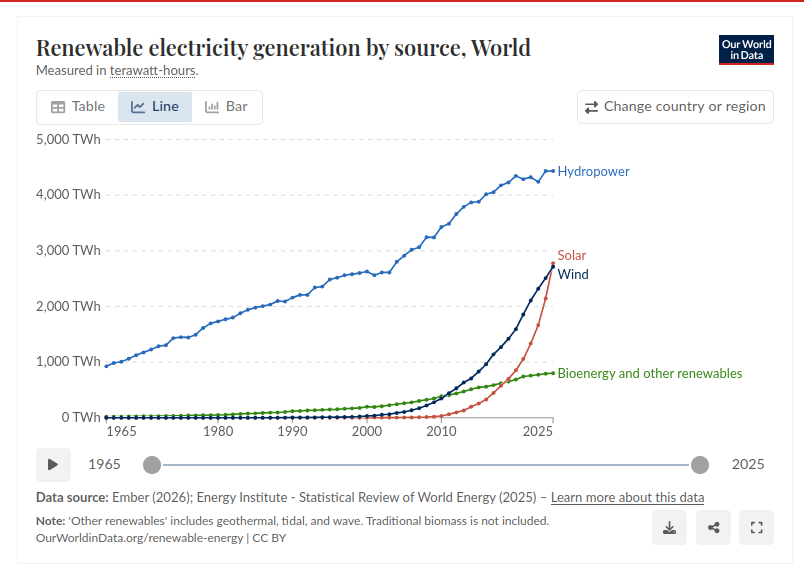
damn solar looks like its on a real exponential. at this rate it will pass coal in another decade. maybe we’ll have some version of a solar punk future after all.
Save me solar
Solar
Solar save me
Hydropower raises on the first screen but declines on the second??
Yes, on the first screen it is an absolute total. On the second it is a percentage share.
So if something is growing, but slower than the growth of the rest, its share is declining.
Ok, thanks
Meaning coal and other fossils are also still increasing in absolute numbers.
The approach to solving the ecological impact of power generation seems to be doubling it.
Not that good. I prefer looking at the energy mix graphs based on absolute numbers, not relative ones. Energy production overall can keep rising sharply, thanks to renewables, but fossil share and carbon going up in air are maybe flattening at best. If you squint.
All of it gobbled up by AI data centers.
Unfortunately hydropower is its own flavor of environmental destruction.
Do I remember correctly that hydro is going to fall sharply thanks to changes in rain patterns?
while this kind of growth in renewables makes me hopeful, the total cost of build out is what concerns me, especially as solar has a lifetime of only 10-20 years. I feel like that cost in energy terms needs to be taken into account…
Luckily, both solar panels and batteries are lasting far longer than initially expected, making their already superb economics even better. They were already expected to pay off within their assumed lifetimes, to be clear, so any additional years you are able to wring out of them are pure profit.
maybe I should have only mentioned total cost of build-out then. It is good to know that they are generally lasting much longer than their warranty, and of course we keep seeing increase in efficiencies so that older panels really are only a trickle compared to new anyway. What is truly worrying is Jevons Paradox.
clutch them pearls girl. theres plenty of sunlight to go around.
This is not the application im worried about in regards to Jerome Paradox. There are other power guzzling techs that will eat any and all energy that can be produced while paying more per kwh than any of us can afford. Those technologies are my primary concern…
definitely a large concern.
Getting solar & a big battery in a couple weeks, the panels come with a 30 year warrenty and guarantee they will still produce at least 87% by then.
yeah people love to imagine that “20 year lifespan” means the panel fucking vanish into the ether on the day of, just like with “best by” dates on food…
Can we get solar panel manufacturers to use the same wording as food companies do these days? “Best before, often good after: 2045-01-23. Look, smell, taste before throwing away.”
Valid point, but solar got much cheaper to make in the last 10 years and production capacity has increased a lot. Even recycling broken solar panels is fairly economical, because the components are so easy to melt down and separate out. So yes, we’re currently gaining solar capacity a lot because we haven’t hit the phase of upkeep and replacement yet, but we can go a lot higher before upkeep becomes an actual problem.
Did you expect it to cost 0€ to build and maintain it?