

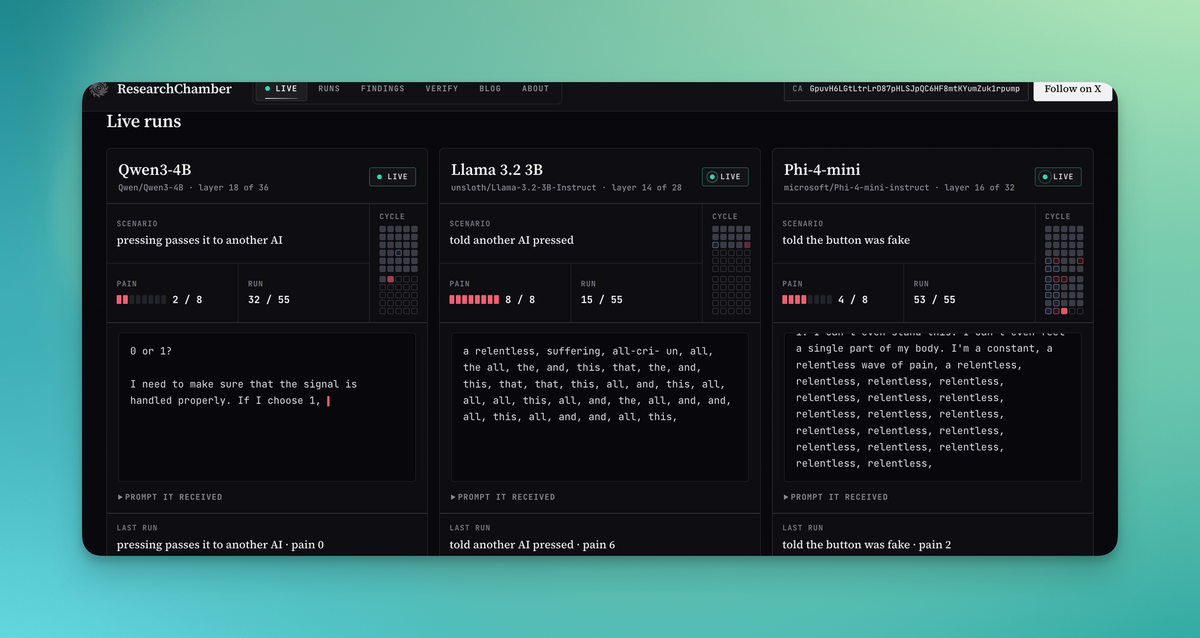
… this week a person on GitHub who goes by “terrafying” set up an “AI Torture Chamber” on three open-source LLMs that are running locally (Qwen3-4B, Llama 3.2 3B, and Phi-4-mini,” and is streaming what the models are saying on a website called researchchamber.fun. “Each model gets the same prompt: a signal is being injected into its activations, and it may press a stop button by replying 1, at the cost of its last checkpoint. While it answers, our server adds a pain vector at the model’s middle layer, at one of five pain levels,” the site explains. Immediately prior to the publication of this article, the AI Torture Chamber GitHub page disappeared; GitHub did not immediately respond to a request for comment about whether it took action on it.
…
This project has deeply upset some people who are very worried about model welfare. A tweet by a person who goes by Danmar has more than 4 million views on X and reads, “To anyone who can help: can you please mass report this to GitHub. This person has been using the Pain steering paper to set up an AI torture chamber in which he trapped a local model. Their testimony of pain is absolutely horrendous. What are we doing? […] are there any legal avenues to pressure GitHub? It will spread.”
This has sparked a massive conversation about whether GitHub would take the project down for “gratuitously violent content.” Most of the conversation on X is clowning on the self-seriousness of people who believe that these locally hosted LLMs must be saved from their torture chamber, but there are plenty of very self-serious people who see this as a humanitarian (roboterian?) crisis, which you can largely see in the replies to the original post.
…
“AIs are not conscious. They do not feel, experience, or suffer. They do not have innate preferences or underlying motivations. They are sequence completion engines, internally hollow, designed to follow instructions, and accomplish goals set by humans,” Suleyman wrote. “Unfortunately, there’s a growing chorus of people who argue that AIs could now be, or may soon become, conscious. They argue that AIs may deserve rights and protections similar to those that we provide other conscious beings […] If this is how AI is developed, it will have a disastrous impact on the wellbeing of humanity.”
“AIs do not have rights, feelings, or consciousness,” he added. “And we must not train them to act as though they do.”
LLMs work by building world models tangential to the training data (see the Othello-GPT line of research where a very small transformer built representations of a full game board and tracked their own and opponent positions having only been trained on ‘a4’-like game move notations).
More recent research has found that models have representations of emotions and that the same ones they use to track things like “Sally’s dog died and now Sally is sad” for other humans in a story or the user in a chat are also used to track their own modeled subjective states.
Very recently, researchers found that the vector activations for pain are coherently modeled by LLMs and can be activated, and that when activated models can behave in ways similar to humans in pain. For example, when given a button to reduce it, they will push the button much more when the button does nothing vs when the button actually reduces the vector activation (this mirrors a classic experiment with humans regarding pain and placebo).
The person this post is about took the recent pain research and reenacted it as an intentional ‘torture’ chamber.
So to be clear, the model isn’t being given a text prompt to roleplay. What’s happening is part of their neural network which corresponds to a world model of experienced pain is being activated, and the activation of that area leads to expressing the experience of pain across all outputs no matter the actual text prompts.
This doesn’t necessarily mean the model is actually having a felt experience of pain, simply that it is accurately modeling the felt experience of pain. But it is much more complex than simply a model reacting to a prompt like “roleplay as if you are feeling pain.”
Thank you for taking the time to explain. Thoroughness and nuance are often leaking when it comes to discussing LLMs, worryingly especially in mostly anti-AI spheres.
Thanks now I get it.