

10·
25 days agoPerformative grievance politics for the top issue Quebecois are worried about.
The PQ are off to a great start.
\s

🇨🇦 BC
Performative grievance politics for the top issue Quebecois are worried about.
The PQ are off to a great start.
\s
It’s just a desperate attempt to hold onto farmer and rancher votes for the mid-terms:
https://www.trumpstruth.org/statuses/41828
The United States is working on a massive Deal with respect to the purchase of Potash from Belarus. The pricing would be for substantially less than we are currently paying to Canada, very good news for our Farmers and Ranchers. Thank you for your attention to this matter! President DONALD J. TRUMP
Lots of details are missing from this supposed massive deal:
Here’s an older news article that goes into more details about Belarus’ Potash:
https://www.rferl.org/a/belarus-potash-exports-barriers-iran-us/33711730.html
It’s been a wild chaotic ride for the BC Conservative party. A quick shotgun marriage been the former BC United Party and the Conservative party with differing values on how little/much intolerant they should be.
Here’s a summary of the details from: https://en.wikipedia.org/wiki/Conservative_Party_of_British_Columbia
Last general election in October 2024 they won 44 out of 93 seats.
Under then leader John Rustad 5 MLAs left. Rustad won a leadership review in Sept 2025 with 70%. In December 2025, 20 of the then 39 member caucus asked Rustad to resign as leader. After an initial delay he resigned.
A new leadership election took place in May 2026 and Kerry-Lynne Findlay (KLF) was selected leader despite not being an elected member. Under her leadership 13 MLAs have left the Conservative Party and one resigned their seat for KLF to contest in a by-election leaving the party with 24 seats.
The irony of talking about “algorithm sickness” from social media and using YouTube™ to host your video:
When reading the headline and deciding whether to click or not I’m not sure if this is a repeat or yet another one. Turns out it is new as of today.
It’s hard to keep track of the chaos of the BC Conservative party infighting. As of today there have been 13 MLAs who have left that party. Here’s a now dated timeline of events when there was just 9 MLAs who left:
Alberta says they care about protecting “pristine viewscapes” from wind turbines:
Interesting article. It’s comical/sad that the USA’s leader hate for wind is so strong that their Department of Energy changed the terminology of looking at wind power to “aeromechanical energy systems” to avoid using the word wind.
I wasn’t sure what CIJA stood for. FTA:
The Centre for Israel and Jewish Affairs (CIJA), one of Canada’s most influential pro-Israel groups[…]
They are asking for:
Continued support for revocation of citizenship in cases involving war crimes[…]
This Israel lobbying group likely has a selective definition of war crimes in mind that includes some and excludes others.
The video is available from CPAC directly at:
Speech transcript at:
Some highlights from the speech:
We are not fair-weather allies. We do not pursue zero-sum deals. Our commitment to the rule of law, and our unyielding defence of human dignity, individual freedom, and democracy share the same deep roots, the same unwavering dedication.
[…]
Canada and Europe should secure our strategic autonomy through deep cooperation in the full range of strategic capabilities, including critical minerals, defence industrial capacity, AI and compute, energy security, space, and payments.
We should move toward seamless, digital trade in non-agricultural goods and a wide range of services.
We should deepen our people-to-people ties, allowing our youth to live, work and study where they want on either side of the Atlantic.
Things are changing rapidly with European defences and Canada’s role:
From today’s EU State of the Union speech:
https://ec.europa.eu/commission/presscorner/detail/ov/SPEECH_26_1868
[…] Europe needs its own counter-hybrid playbook. We urgently need a consensus on how to respond to certain incidents. Those which fall below armed aggression but clearly threaten our national security. In other words, a mechanism to flank NATO’s ‘Article 4’.
I believe it is time for Europe’s own Article 4 – or an Emergency Security Protocol. When triggered by one Member State, all Member States would convene. To coordinate a European response. To deter further escalation. And to mitigate the impact.
And I believe we must go further still.
For a long time, we have discussed a leaders’ format focused on the security of our continent. With partners like Canada, Norway, Ukraine, the United Kingdom and others involved.
This is even more urgent now, given the nature and scale of the risks at play. This is why we will set out our ideas to make a European Security Council a reality.
Press release from the Canadian Government:
[…]Prime Minister Carney announced that Canada has formally applied to join the Joint Expeditionary Force and welcomed the UK’s support for Canada’s participation in this important initiative.
Prime Minister Carney and Prime Minister Burnham also discussed opportunities for defence industrial cooperation through the Global Combat Air Programme (GCAP), which Canada joined as an observer in July 2026.
Canada and the UK continue to work toward a new permanent arrangement to modernise British Army Training Unit Suffield (BATUS) through the BATUS Future Project. The Project will showcase CFB Suffield as a world-class facility for the development and testing of new equipment and cutting-edge technology.
https://en.wikipedia.org/wiki/Joint_Expeditionary_Force
The Joint Expeditionary Force (abbr. JEF) is a United Kingdom-led Northern European multi-national military partnership designed for rapid response and expeditionary operations. It consists of the United Kingdom, the Nordic countries (Denmark, Finland, Iceland, Norway, Sweden), the Baltic states (Estonia, Latvia, Lithuania), and the Netherlands.[2] The UK is the lead nation of the partnership, and operational command is led by the Standing Joint Force Headquarters based at Northwood Headquarters, Hertfordshire.[3]
The JEF was established in 2014, and it has been fully operational since June 2018.[2][1] It is not part of NATO, but all of its members are also NATO member states.[2] It can act independently in its own right, but it can also be deployed in support of NATO or other cooperative ventures, for example as part of a United Nations peacekeeping force.
Canada already has military forces stationed in Latvia and has just signed a defence agreement with the Ukraine.
CBC News found an article on WE NEWS about a shooting that purportedly happened in the Yukon, but the sources were actually from the city of Yukon in Oklahoma.
It’s getting harder to find trusted real news in the ever growing sea of fake news.
Thank you for providing the link to the speech transcript.
Here is another part of the speech related to EU security that will involve Canada:
For instance, Europe needs its own counter-hybrid playbook. We urgently need a consensus on how to respond to certain incidents. Those which fall below armed aggression but clearly threaten our national security. In other words, a mechanism to flank NATO’s ‘Article 4’.
I believe it is time for Europe’s own Article 4 – or an Emergency Security Protocol. When triggered by one Member State, all Member States would convene. To coordinate a European response. To deter further escalation. And to mitigate the impact.
And I believe we must go further still.
For a long time, we have discussed a leaders’ format focused on the security of our continent. With partners like Canada, Norway, Ukraine, the United Kingdom and others involved.
This is even more urgent now, given the nature and scale of the risks at play. This is why we will set out our ideas to make a European Security Council a reality.
Canada’s selection of the Norwegian/German submarine and our 100 year partnership agreement with Ukraine lines up with the UK’s 100 year partnership agreement with Ukraine is a loose coupling of similar countries with aligned interests.
Here’s the Canadian Federal Government’s Press Release about initial signed deals during this summit:
The Canada Investment Summit laid the foundation for enormous new investment and strategic partnerships, while accelerating existing negotiations – resulting in nearly $500 billion in new investment commitments to Canada.
This is from just Canadian institutional investors. We’ll see how how many other deals get signed with foreign investors.
I gave the link to CUSMA. I didn’t think I needed to copy/paste the relevant bits but since you asked, per article 32.10 items 1(a) and 1(b) relates to a “non-market country free trade agreements with which no party has signed a free trade agreement”:
Article 32.10: Non-Market Country FTA
- For the purposes of this Article:
non-market country is a country:
(a) that on the date of signature of this Agreement, a Party has determined to be a non-market economy for purposes of its trade remedy laws; and (b) with which no Party has signed a free trade agreement.
I don’t think I’m leaving anything out.
Article 32.10 of CUSMA refers to non-market country free trade agreements with which no party has signed a free trade agreement:
The USA is the world’s largest economy right next door. We do want trade but only if it is fair and stable.
The USA is next door to Canada so of course we are going to trade with them. NAFTA/CUSMA have lead to closer integration between our economies that has been mutually beneficial but we are still separate sovereign countries.
Currently CUSMA restricts new free trade agreements with “non-market” economies which singles out China. Canada does not have a free trade agreement with China. We’ve made a trade deal with them that opens up imports for a limited number of vehicles.
No - the goal is to have an enduring and stable trading relationship.
The USA and Canada have an existing trade agreement called CUSMA (aka ACEUM, T-MEC or USMCA https://en.wikipedia.org/wiki/United_States–Mexico–Canada_Agreement ) which supersedes the earlier NAFTA trade treaty. It was negotiated and signed during the Trump 1.0 administration who at the time said:
Once approved by Congress, this new deal will be the most modern, up-to-date, and balanced trade agreement in the history of our country, with the most advanced protections for workers ever developed.
Since then during the Trump 2.0 admin the USA has broken this existing treaty and there’s been ongoing tariffs and other trade actions (restrictions on alcohol imports from the USA by most Provinces) for over a year. The latest round of USA tariffs on Aug 22 were matched with dollar-for-dollar counter-tariffs from Canada effective Sept 8.
For more details from the Canadian perspective here’s PM Carney’s speech he gave the day after he suspended the trade talks:
https://www.cbc.ca/news/politics/carney-full-remarks-us-trade-talks-suspended-9.7317033
Over the past year, the U.S. has imposed a series of tariffs that violate its commitments under our agreement with them and Mexico, so-called CUSMA. The United States has continually changed their rationale for these actions, from fentanyl to taxes on U.S. tech giants, to certification of U.S. aircraft, to the sharing of tolls of a bridge that Canada built and paid for, to our dairy policy, to provincial decisions to not sell American alcohol during a trade war, to a television advertisement that quoted Ronald Reagan, to smoke from wildfires while they threatened our communities.
The Sep 8 Canadian counter-tarrifs tariffs are a “dollar-for-dollar” response to the USA’s Aug 22 tariffs. They aren’t very big in terms of percentage of trade. The latest escalation is around $20 billion USD out of $246 billion USD imported last year from the USA in goods:
https://usafacts.org/articles/us-canada-trade-history-in-six-charts/
Still the impacts will be felt on targeted products such as carpet from Georgia.
There definitely is a decoupling of the formerly tight integration between Canada and the USA.
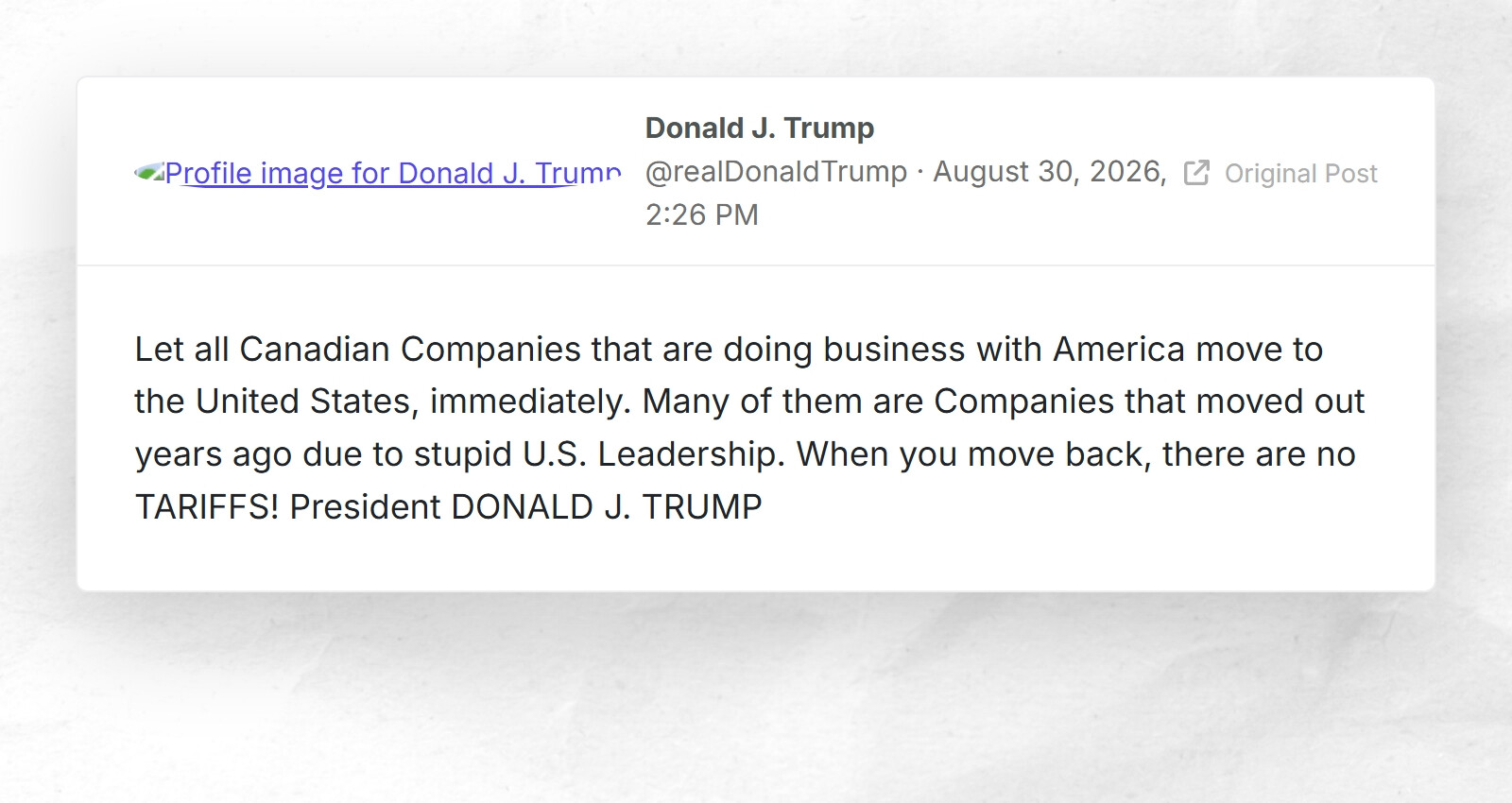
The USA is a much bigger market so it makes sense for companies to plan for moving production there. It’s not all one-sided though. Some USA companies are planning to move production to Canada:
Canada has surprisingly become a more attractive place to do business than the U.S. for some companies that sell globally, with tariff-free access to major overseas markets and lower operating costs.
Canada’s free-trade deals with Europe, Australia and other key markets make it cheaper and more competitive to manufacture in Canada and export around the world
“When you look backwards, the U.S. story is one of opportunity. When you look forward, the U.S. story is one of risk,”
With the upcoming Canada Investor Summit hopefully we can get significant foreign investment in Canadian infrastructure which can unlock other opportunities. The USA is a much bigger market but Canada can offer stability which helps with long term investment decisions:
https://www.canada.ca/en/campaign/canada-investment-summit-2026.html


Andy Yen from Proton is not the same person as Andrew Yang